No technical jargon or aviation procedures required. No names mentioned, just a big question. Why?
The following is about my annual line check whilst flying for an Italian company some years ago. It was actually my check after initial company line training, and the primary reason why I decided to leave.
After about four weeks of line training I was finally scheduled for my line check. A check which every pilot has to undergo when joining a new company, well your name could be Frank Abagnale!
I was rostered to operate a four sector day from Milan to Ibiza, returning to Bergamo, before flying back to Ibiza and then home to Milan. Tiring enough without having your every action scrutinised by a training captain.
So I arrived at the briefing office nice and early at Milan’s Malpensa airport’s terminal two, to give myself enough time to go through the pre-flight paperwork and meet the rest of the crew. I was paired up with a co-pilot whom I had not flown with before, but had met around the office, a very nice and helpful chap. That was the good news; my training captain was infamous in the company for being a bully and difficult to work with. However, I had not met him before and was willing to make my own mind up and form my own opinions.
The briefing office was not huge, just big enough to contain one round table with space for five chairs, and a larger rectangular table, along with filing cabinets and pilots’ mailboxes. I sat down at the round table with my co-pilot and we started working through the paperwork, flight plans, weather, route information &c.
The storm was about to start, in walked my training captain, he looked at me and asked, “Why are you sitting there, come on the other tables better!” he tutted, shaking his head and started talking rudely in Italian to my co-pilot.
Great start I thought, I just stood up and offered my hand, and I suppose sarcastically opined, “By the way my name is Alan!”
Nothing I could do was right, and when he asked how much fuel I wanted to take for the first sector which was a tanking sector, he countered my suggestion. “No, come on you’re a professional, look we can expect up to twenty children, that’s at least another ton you can take.”
“Yes, but if this number of children is wrong, then we’ll be overweight for landing!” I replied. I was amazed at his reply, “So what we’ll just change the zero fuel weight in the FMC.” Incredible attitude I thought!
So pre-flight duties completed we met up with the rest of the crew, and headed off to the aircraft, you could have cut the atmosphere with a knife, my crew for today were literally in fear of this man, not good.
Anyway out at the aircraft the atmosphere just got worse. Going through my pre-departure procedures, this bully shouted at my co-pilot and I to hurry up because if we missed our slot I could pick up my bag and leave as I would be fired…his exact words. I replied. “What slot, no one has told me that we had a slot?”
“I know, so you should too,” was his answer, he had been told but decided not to pass on this information, great I thought, what ever happened to teamwork.
He started yelling at my co-pilot to ask for pushback clearance, I advised him that we were not ready, but he wouldn’t listen and started shouting in Italian at my co-pilot.
Pushback clearance was obtained and I hastily configured the aircraft and we pushed back without the necessary checklists being completed. By now I had had enough, and was planning my letter of resignation. During taxi out to the runway, all I could hear from this idiot behind me was come on hurry up, followed by more tutting and sighing.
Well, we made our slot and took off, once level in the cruise I handed over control to my co-pilot and took off my headset, and turned around to speak to this so called training captain that was sitting on the jump seat behind me.
“I have been flying for twenty five years, and deserve a bit more respect than what you are showing me. On our return to Milan I will decide if I am going to work for this company…..not you!” With that he shut up a bit, well until our approach into Ibiza anyway.
On final approach into Ibiza he said “You better do a smooth landing we carry people not animals.”
There was venom in his voice and attitude; fortunately my landing met his ‘high’ standards!
The next two sectors were to be flown by my co-pilot, but he was so nervous with being constantly bullied, that he screwed both landings up to the extent that I had to take over control and salvage the landings. His answer was “Good, this company can’t afford go-arounds”, a frightening concept to drill into pilots, and one that I considered wholly unacceptable.
On taxi out at Bergamo we were behind a Flightline Bae146, who my ‘training’ captain considered to be taxiing too slowly, “I hope he has an engine failure on take-off”, he shouted out…crazy, crazy, crazy attitude I thought. Do you know what, as this aircraft started its take-off roll, there was a large puff of smoke from one of its engines, and they rejected the take-off. This was met with the same glee from him as a cup final goal being scored in the 90th minute!
Well, I survived the day, but he never told me if I’d passed. This bully realised that I would not cowtie to him, and all he said was “Today I just wanted to see how much pressure I could put you under, and you did OK.”
****** I thought and flew home that evening to London. I telephoned my agent, and explained that I was considering resigning, but was talked out of it, as it was explained that I only had to fly with this guy once a year!
I have to admit it took me almost a week to calm down, and I am not exaggerating.
As a post note, we never exchanged Christmas cards!!!!!!
Friday, 14 December 2012

THIS WAS ORIGINALLY POSTED SOME YEARS AGO ON MY FACEBOOK PAGE....IT WAS READ AT THE FUNERAL OF MY OLD CHIEF PILOT AND IS STILL VERY APT......
I hope there's a place, way up in the sky.
Where pilots can go, when they have to die.
A place where a chap can have a cold beer.
With a friend or a comrade whose memory is clear.
A place with good graces, no hook or slice.
While all landings are smooth and you never bounce twice.
Just a quaint little bar for a chat and a smoke.
Where they like to sing loud, and love a good joke.
The kind of a place where a lady could go.
Feel safe and protected by the men she would know.
There must be a place where old pilots go.
Where their plans are all finished and their airspeed gets low.
Where the whisky is old, and the women are young.
And songs about flying and dying are sung.
Where you'd see all the fellows you'd flown with before.
Who would call you your name, as you come through the door.
Who would buy you a drink, if your thirst should be bad.
And say to the others, "He was quite a good lad!"
And then, through the crowd, you'd spot an old guy.
You had not seen in years, though he'd taught you to fly.
He'd nod his wise head, and grin ear to ear.
And say, "Welcome, my Son I'm pleased you are here!"
For this is the place where true flyers come.
When their journey is over, and their life is all done.
They come here at last so far up above.
To be close to their pals and to those whom they love.
Where all hours are happy and old boys can rest.
This is heaven my son, you have passed your last test.
A wee bit sad, but happy too.....
Where pilots can go, when they have to die.
A place where a chap can have a cold beer.
With a friend or a comrade whose memory is clear.
A place with good graces, no hook or slice.
While all landings are smooth and you never bounce twice.
Just a quaint little bar for a chat and a smoke.
Where they like to sing loud, and love a good joke.
The kind of a place where a lady could go.
Feel safe and protected by the men she would know.
There must be a place where old pilots go.
Where their plans are all finished and their airspeed gets low.
Where the whisky is old, and the women are young.
And songs about flying and dying are sung.
Where you'd see all the fellows you'd flown with before.
Who would call you your name, as you come through the door.
Who would buy you a drink, if your thirst should be bad.
And say to the others, "He was quite a good lad!"
And then, through the crowd, you'd spot an old guy.
You had not seen in years, though he'd taught you to fly.
He'd nod his wise head, and grin ear to ear.
And say, "Welcome, my Son I'm pleased you are here!"
For this is the place where true flyers come.
When their journey is over, and their life is all done.
They come here at last so far up above.
To be close to their pals and to those whom they love.
Where all hours are happy and old boys can rest.
This is heaven my son, you have passed your last test.
A wee bit sad, but happy too.....
A DAY IN THE LIFE OF A HAJJ PILOT PART 1
THIS WAS ORIGINALLY PART 1 OF AN ARTICLE PUBLISHED IN AIRLINER WORLD MAGAZINE.
Briefly, an explanation is needed; the Hajj is a five day
annual pilgrimage made by those of the Islamic faith to their holiest site,
Mecca in Saudi Arabia; this is often combined with a less important stopover at
the second most holiest city Medina, around 250 miles to the north of Jeddah.
As a Hajj pilot based in the Middle East you would very quickly become very
familiar with these two airports.
This was to be my second Hajj operation; two years ago I
flew the Boeing 737-800 for NEOS, an Italian airline based in Milan, whilst
subcontracted to Nasair in Eritrea. Great fun, but this year would be totally
different. I would be based in Baghdad and flying the Boeing 747-400 on behalf
of the Hajj Commission under Iraqi Airways AOC. Operating to Madinah, Jeddah,
Basra, Erbil and Sulaimaniyah life as a contract pilot is seldom dull!
During the period which the Hajj operates, the role of the
airline pilot is to primarily transport these pilgrims from cities all over the
world to Jeddah, this being the nearest airport to Mecca, and site of the
incredible Hajj terminal.

JEDDAH’S SPECTACULAR HAJJ TERMINAL
And secondly to the city of Medina which has, literally, as
its centre-point the ‘first’ Mosque.
However, the role of the Hajj pilot involves operating in an
environment which to most commercial pilots would be completely alien,
especially when operating out of Iraq to-boot! Hopefully the following will
highlight this ‘unusual’ operation.
Our hotel in Baghdad, though not in the protected ‘green
Zone’ is nevertheless in a ‘secure’ enough area, being protected by three
security rings which surround the Baghdad International Airport, formerly
Saddam International Airport. Hints to this dictator’s past can still be found.

REMNANTS FROM THE PAST CAN STILL BE FOUND
Our final line of defence is provided by a private security
company which posts guards armed with their AK47s at the entrance and around
the hotel’s periphery, as well as a multitude of closed circuit television
cameras. Although this did not stop the American forces ‘raiding’ the hotel
recently, ordering everyone out of their rooms at gunpoint as they believed
that two al-Qaeda operatives had infiltrated the guests.
Also, there are the occasional mortar and rocket attacks
where the insurgents’ fire in our general direction, primarily aiming for the
large American airbase attached to the airport and their ‘Camp Victory’
facilities. One such attack took place just a couple of nights ago with the
impacts occurring at ‘French Village’ located just over a mile from our hotel.
The resulting explosions shook the hotel, which is why our beds are not flush
with the walls, in-case anything becomes dislodged then this will not fall on
our heads whilst sleeping!
Today’s flight is scheduled to depart at 0200 local time, however,
as a crew we know that this will never depart on time; making our schedule of
Baghdad-Medina-Baghdad a long day out indeed. Even though we will only be
flying short sectors, with none of them more than two and a quarter hours each,
however, it is what happens on the ground before departure and during the
turn-around which takes up most of the duty day.
So with our crew assembled, comprising twelve cabin crew
(the minimum legally required to operate our fully laden Boeing 747-400), one
ground engineer who flies with us plus myself and my co-pilot we depart our
hotel in its rickety old shuttle bus for the airport and the first of many
security checks.
Our Iraq Airways identity cards are checked prior to
entering the airport’s terminal area at its last roadside checkpoint and then
after disembarking from the bus we are instructed to line all our crew bags up
where the ‘K9’, the sniffer dog, checks them for explosives. We are given a cursory
hand search, men in the open, women in a curtained off booth. With these checks
completed, we are allowed to enter the airport terminal building itself, after
our bags have been x-rayed and we’ve passed through a normal airport body
scanner.
Time for the crew to split up with the pilots heading off to
the Iraq Airways flight operations to collect the flight plans, weather and
notams, our purser accompanies us to collect the General Declaration. This document
allows us to retrieve our passports which are held by the airport’s immigration
officers during our layover in Baghdad.
With the paperwork completed we repeat the x-ray and body search
processes three more times before being allowed on-board our white tailed Boeing
747-400. As of yet the airline’s colour scheme has yet to be painted onto the
fuselage, its registration YI-AQQ, an ex-JAL aircraft with a 420 seat
configuration, 70 business and 350 economy towers over the other aircraft on
the airport’s apron.

MY FABULOUS, YET TO BE PAINTED ‘TOY’ ON THE MEDINA RAMP
Once on-board one of the aspects of this type of operation which
I relish is that the crew has to do everything, chase everything and organise
everything, just to keep it all going. Our South African ground engineer not
only completes his transit checks and refuelling of the aircraft, but also
ensures that the baggage pallets have been loaded where we want them to be and
that the cargo hold locks have been activated correctly. With the fuel we tend
to uplift as much from Baghdad as we can, where it is six times cheaper than in
Saudi Arabia. So 130,000 pounds has become our standard fuel figure departing
Baghdad, which is sufficient to fly to either Jeddah or Medina and then still
have sufficient remaining for the return sector to Baghdad, with full reserves
and ‘some for mum’.
Our aircraft is in excellent condition and has been
extremely well maintained but even so, as in any airline faults occur and at
the moment our APU is not working, whilst we are currently waiting for a new
starter to arrive. This condition throws up more operational considerations, as
we need ground electrics as well as ground air carts for engine starting. We
also need ground air conditioning units as even at this time of the morning the
aircraft interior heats up rapidly during passenger boarding.
On-board our cabin crew have to complete their own security
checks, liaising with me for a check of the PA and cabin evacuation systems,
whilst also ensuring the aircraft is clean, the water and toilet systems have
been correctly serviced and that we have sufficient catering on-board.
In the cockpit whilst managing the overall operation we have
our own tasks to complete, such as completing the initial cockpit set-up where
we ensure that all the switches are correctly set, loading the FMS (Flight
Management System) with route, navigation and performance information for this
flight, so this is literally both the heart and brains of the operation. We
also have to complete the load-sheet in triplicate and the trim sheet too, this
will confirm that the aircraft is correctly loaded and within all structural
limits. Not such a big deal for us, because even with a full load and tankering
fuel, we are still comparatively light for a Boeing 747-400 on take-off, around
650,000 pounds, compared with our maximum allowed take-off weight of 830,000
pounds.
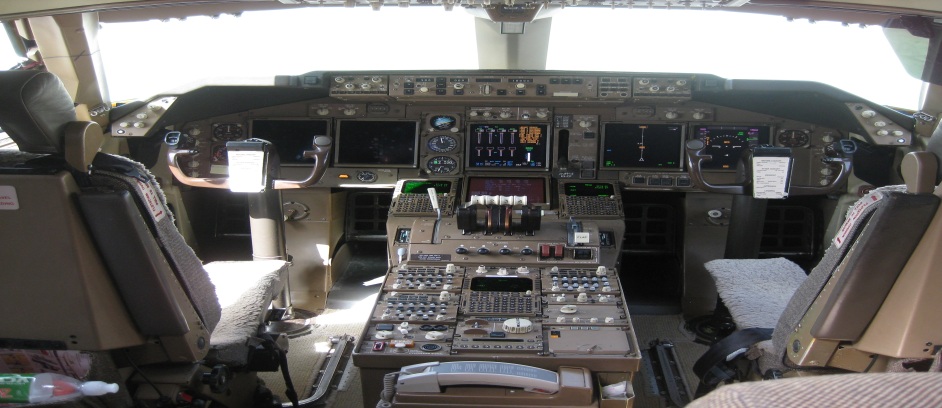
OUR COCKPIT WAITING TO BE POWERED UP
You have to keep on top of what is going on, or more often,
not going on and realising that we were still not boarding passengers, it is up
to us to find out why. So leaving the cosy environs of the cockpit I ascertain
from our ramp agent that our passengers would not be boarding for another three
hours as they had been held up by enhanced security checks entering the airport
as a result of the multitude of bombs which exploded in downtown Baghdad this
evening. The Hajj operation generally is a case of ‘Hurry Up And Wait’ and
operating out of Iraq just exacerbates the situation.
Well eventually, with dawn threatening to rise and our 0200
departure time nearly 3 hours behind us, passenger boarding is finally
completed. As I will be PF (Pilot Flying) down to Medina, I complete a
departure and emergency briefing, covering discussion items relating to what
will happen and what we hope will not.
With the calculated zero fuel weight (the weight of the
aircraft, passengers and baggage) entered into the FMS we check our performance
charts to see what power setting can be used. At this weight we can use a
maximum de-rate, by using an assumed temperature of 55 degrees, this allows us
to reduce the wear and stress on the engines and so prolong their life. We use
the speeds calculated now by the FMS for take-off, V1 (decision speed in event
of a critical malfunction occurring during take-off, defined as the maximum
speed at which the initial actions to reject the take-off must be commenced. Vr (the speed at which we rotate, initiate the
actions required to become airborne) and V2 (the engine out target speed).
Checking that both the V1 speed is annunciated on the PFD (Primary Flight
Display) as well as the V2 speed also, once we’ve manually set it on the speed
selector window of the MCP (Mode Control Panel).
With the pre-flight and before start checklists completed,
it is time to review the supplementary procedures as the APU is inoperative for
starting the first engine whilst parked on the gate using an external air
supply. We need to start engine number four first then disconnect the ground
services before pushing back. Then once the pushback is completed we can use
the cross-bleed start checklist for the remaining three engines. This involves
increasing thrust on the operating engine so that there is sufficient bleed air
to start the remaining engines.
We have now been on duty nearly six hours and only just
reached a position where we can call ATC for taxi clearance. Completing our pre
taxi procedures requires selecting the flaps to twenty degrees and checking the
full and free movement of the control surfaces against their display on the
status page of the lower EICAS (Engine Indicating Crew Alert System). Finally,
we complete the after start checklist, and we can depart under our own power.
Baghdad ground control issues us with our transponder code
and clears us to taxi to the holding point of runway 33 Right via taxiways
Yankee and Sierra. Now these are not denoted on the Jeppesen taxi charts, but
having operated out of Baghdad now for the last couple of months we know the
routing.
There is no need to increase engine thrust as we are so
overpowered at this light weight that simply releasing the parking brake causes
the aircraft to start moving, this brings its own concerns as we have to be
careful with the brakes, not ride them and cause them to unnecessarily heat up.
Tyres need to be nursed as well watching for a maximum speed of ten knots in
turns and thirty knots in a straight line before slowing back down again. As
with preserving the engines we need to also minimise the wear on the tyres and
brakes due to the difficulty in getting spares and maintenance with the
resultant high costs in this part of the world.
Having been advised by our purser that the cabin is ready
for take-off we complete the before take-off checklist, being advised by ground
control to change frequency over to Baghdad tower, we await our departure
instructions
Looking over to my left, I can see to the south east of the
airport the silhouette of one of Saddam’s palaces, a monstrosity surrounded by
ornate lagoons and villas. Approaching the holding point at the runway’s
threshold, I slow the aircraft down, anticipating that there will be no delay
to our departure, just our ATC clearance to come.

SADDAM’S PALACES, VILLAS AND LAGOONS……
Although there are SIDs (Standard Instrument Departures)
prescribed for Baghdad airport, for obvious reasons it is best not to fly
routes which can be planned for in advance and monitored by third parties who
might have criminal intentions. Therefore just prior to take-off we are given a
heading to fly after departure and clearance to climb to five thousand feet. The
heading takes us away from the city and out over the desert and relative
safety. The memories of what happened to the DHL Airbus A300 are always there, made
more poignant as it is parked less than two hundred yards from the hotel we
stay in here!

THE DHL AIRBUS A 300, SO EXPERTLY BROUGHT BACK DOWN TO EARTH
With the cabin crew notified over the PA system of our
impending take-off I review our immediate actions when airborne. With the
undercarriage selected up I remind us that all exterior lights are to be
switched off to, the cabin crew have already been briefed to switch off all their
cabin lights.
It’s very ghostly here as at night on the ground in Baghdad
you can hear many aircraft and helicopters flying around, but it is impossible
to see any of them, as nobody flies around with lights on here, again for
obvious reasons.
With take –off clearance received and lined up on the
runway’s centreline I advance the four thrust levers to 70%N1 and check for
stable power indications before depressing the TOGA (Take Off Go Around)
switches. Now the auto-throttle system automatically advances the thrust levers
to our previously selected power setting, and our take-off roll commences.
With a call of ’80 knots’ to cross check airspeed
indications and that neither pilot is incapacitated, we quickly accelerate to
V1 and shortly after Vr. Initially climbing away at 165 knots and with a
positive rate of climb confirmed, I ask for ‘gear up and lights off’. At four
hundred feet above the ground I ask for the Heading mode to be selected to
correctly direct the flight directors and following its commands bank the
aircraft in the required direction to pick up our previously cleared heading.

INITIAL CLIMB FROM BAGHDAD, LOOKING AT THE AIRPORT’S CIVIL TERMINAL
Now flying outside the relative safety of the airport’s
perimeter, we head south west and out over the desert. Our ND (Navigation
Display) portraying many TCAS (Traffic Collision Alerting System) targets;
helicopters, UAVs (Unmanned Air Vehicles) and other random military traffic
with fabulously imaginative call-signs. However, we were being expertly and
assuredly looked after by the American Air Traffic Controllers and our day out was
about to begin in earnest.
Monday, 10 December 2012
ONE DAY, IN AND OUT OF AFRICA!
Okay, doom and gloom first, best get it out of the way
now. In the current economic climate, to be honest there are few options for
those pilots who are looking for their next, or maybe their first job. Unless
of course you fancy working in West
Africa , China Lagos
The days of becoming a Hamster (BEA and junior BOAC pilots
know what I mean) or a re-born Virgin are long behind us and for most, dipping
their toes into the world of contract flying could be the only way of securing
employment. Even these two ‘legacy’ carriers that I’ve just mentioned are
amongst dozens of others which are looking at reducing the number of personnel
in their flight ops departments. But don’t be scared about contracting, having
experienced career airlines such as Dan Air, Virgin Atlantic and Thomsonfly, I
thoroughly recommend it.
Okay the financial security is not there, but where is it
anywhere at the moment? This was personally brought home to me by watching two
of my previous airlines’ pensions shrivelling up; one alone lost 22% in the
last year, unfortunately not the ex-wife’s 22%!
But, if you’re willing to consider a 12 month contract to
just tide you over in the short term, then believe it or not there is still a
lot of choice out there in the job market, although to be honest the options as
I previously intimated are generally in the less salubrious areas of the world.
Which in my own opinion is what makes them more interesting, especially places
like Seoul Bucharest Casablanca Asmara
Okay our industry is in a downturn, but those of us who
have been around the block more often than one of Blakey’s buses knows that
this is cyclical. (By the way, one of my co-pilots in Virgin Atlantic actually
appeared in one of the ‘On The Buses’ films. Don’t worry, I won’t embarrass you
any further Andy!) Well, over my last twenty five years in this industry I’ve
seen it before, and the good times will return; it may just take a bit longer
this time.
So to explain where I am going with this, I have recently
returned from enjoying my latest experience, adventure as my long suffering
wife calls it, and the following ‘story’ highlights just one of those days,
those long, long days! I say long day as I should have learnt from my brief
time flying the DC10 for a Zimbabwe registered freight company, that ‘Flight
Time Limitations’ in Africa were looked at as merely a daft suggestion than a
rule. Therefore the day out which I shall shortly explain would never happen
to, nor be tolerated by say, a British Airways pilot, and quite rightly so! But
then it’s one of the ‘perks’ of being a pilot in the up and down world of
contract flying. You need to manage the situation yourself and the need for
flexibility and understanding of your environment is paramount to keeping the
operation going whilst never forgetting, always being safe. Bizarrely, do you
know what though; I wouldn’t swap this topsy-turvy lifestyle for all the weeks
on the beach in the Caribbean , or weekends
shopping in New York Miami Manhattan Tokyo
Well, this latest adventure was to be a new one on me, as
after operating from more than 200 different airports on five continents; I
still had to look up the place that I was being sent to in my nine year old
daughter’s atlas. You see, whilst being employed by a UK aircrew agency Avcom,
though my contract was ‘conveniently’ registered in the Cayman Islands and
subcontracted out by them to a small Italian airline Neos, which was based at
Milan’s Malpensa airport; I was sent on a detachment for a relatively new
Eritrean airline Nasair, by the way that’s in Africa, but you probably guessed
that from the title of this piece! I think my lawyer would have fun tracing
back any liability issues!
For the spotters I’ve probably added two new airlines to
their hit lists, as I too had never heard of either airline until I’d become
directly involved with them. Briefly a little bit of history to appease the various
marketing departments. Neos, initially partly owned by TUI ,
started operations in 2002 with a single B737-800W whilst Nasair commenced
flight operations in December 2006 initially with a not so new B737-200. Back
to Neos briefly, even though the company was from a ‘civilized’ European
country, their training department and method of operating the B737NG came as
quite a culture shock, but there in lies a tale for another time!
So back to now, there were seven of us in all on my crew,
five flight attendants and two pilots. We were to be based for around two weeks
in Asmara
Now I’m no stranger to Africa
but early impressions, infact it only took five minutes to be exact after
disembarking from the Yemeni airlines A310, the one which is sadly now at the
bottom of the Indian Ocean , and walking across
the unlit ramp to the overcrowded and steaming arrivals hall, for my suspicions
to be confirmed. We had been travelling for the whole day from Milan Rome Yemen Asmara Africa .
Especially as a couple of days later it seemed that we’d exhausted all of the
local tourist attractions after visiting the heavily guarded tank graveyard,
three octogenarians with locally issued sticks, and the 1950’s bowling alley!
By the way the bowling alley had no means of automatically picking up the pins
after they’d been knocked down, so you were allocated a young local lad who hid
behind the pins to do this for you. This after several beers created a whole
new sport!
My crew on this detachment consisted of a real character
and all round nice guy in Leonardo my co-pilot and the five fabulous cabin crew
led by the senior cabin crew member Ermelinda. After completing all of the
airport’s arrival procedures, in triplicate, we shoehorned ourselves and our
luggage into the dusty hot Nasair minibus for the short drive to our hotel. Once
again using just first impressions to go on, I was preparing for a bit of a
disappointment. We pulled up in front of the most decrepit looking hotel I’ve
been forced to stay in, and I’ve stayed in Tashkent Lagos Hull
Back to why we were here, good news, we were escaping from
Asmara
Our day started with the same battered old company minibus
from a few days prior, picking us up at the crack of dawn from our hotel, the
temperature outside was only just above freezing as even though Asmara is in
East Africa; its elevation is almost 8,000 feet above mean sea level, the cold
and thin air not helping the smokers amongst the crew! The drive to the airport
only took fifteen minutes along the dusty potholed roads, past the UN complex,
dodging the early morning traffic of goats and wobbly cyclists!
On reaching the airport we passed through what amounted to
a ‘gesture’ towards security, I swear the screening machines were probably not
plugged in! On the surface though, I must say that their system appeared much
better than the shed and clipboard operation of the Lagos Asmara Africa , but this was one joker that I wanted to keep up
my sleeve for when I felt that I really needed it!
However, our first and most important job on being
presented with the wad of paperwork was to complete the government currency
declaration forms, with to us their obvious flaw, I could tell you why but I
won’t! Next task was to make a decision on the fuel which we required to have
on board to fly the one hour sector to Jeddah, very simple this last one. In Asmara JET A1 fuel available to us, even though there’s a
fuel farm located on the airport. I should imagine this is reserved for the
mighty Eritrean air force, which in Asmara Asmara Khartoum
So pre-flight briefing complete, especially as Leonardo
had already prepared as far as he could manual loadsheets and ATC flight plans
whilst in the hotel, such was his efficiency and professionalism which I was to
find would be echoed frequently over the next week or so. It was again time for
another foray for us through one more ‘security’ checkpoint, after which we
were allowed to stroll out to our aircraft. Health and safety nitwits would be
jumping up and down at this, as there was not a high-viz jacket in sight! Well,
to be honest the only thing moving on the ramp were the two birds which our
engineer had flushed out of the APU exhaust on our aircraft, and also now that the
sun had risen we were lucky as the temperature was starting to do so also. As
mentioned the apron was not exactly a bustle of activity, there were only three
other aircraft, two of which were Nasair B737-200 aircraft being tended to by a
couple of scruffy Russian engineers. I’ll add here, that a couple of days later
when we had to return to the airport to put our aircraft to bed and complete
the mid term parking procedure, you see it was to be staying on the ground for
a while, these two characters waved us onboard the most knackered looking of
these two aircraft. Wanting to know, by just using hand signals but we got the
gist, if we could assist them with some urgent engineering. Which unfortunately
we couldn’t, but on our way out through the ‘business class’ section being nosy
we peered into the flight deck, where I was surprised to see that on the
glareshield they had wired up the same type of Tom-Tom satnav that you could
buy back home in Halfords!
The only other airworthy looking aircraft on the ramp was
an Eritrean airline’s B767, which not surprisingly also appeared to have seen
better days. In comparison our shiny and spotless looking aircraft was a pearl
cast amongst swine, parked as it was in the cheap seats as far from the airport
terminal as was physically possible. The aircraft was one which Neos had picked
up from the unfortunate demise of Excel Airways in the UK and now placed on the
Italian register, and having been repainted, in what are basically TUI colours but with the NASAIR logo on the side of
the fuselage, and I must say looked very smart.
Our ground engineer, a great chap called Rory who was a
Dutchman from Nairobi but married to an Eritrean lass, was sat in the forward
left doorway of our aircraft, his legs casually dangling over the side as he
wrote up the daily check in the technical log, a set of insubstantial and
wobbly step ladders reaching only halfway up to this open doorway not a site
that I’d ever witnessed at London Heathrow! Now I could not imagine the female
cabin crew with their high heels, climbing up this ladder and pulling
themselves up the final three feet to board the aircraft. But this was what our
still smiling ramp agent insisted that we needed to do, the reason being that
Nasair had not paid their last bill to the airport authorities, so in return we
were to receive no assistance with ground operations! I could see Rory looking
down at us as we approached grinning away, and I could visualise him mouthing,
‘welcome to Africa !’
Once I had diplomatically persuaded our ramp agent, and
that he realised that this flight was not departing using a step ladder, he
sprung, sorry loped into action. Fifteen minutes later a knackered looking
tractor fired up and spewing blue and black smoke pulled an equally looking
knackered set of steps towards us, five minutes of comic too and frowing and
the steps were sort of in position.
Leonardo busied himself with the pre-departure safety check
and the preliminary flight deck inspection, the APU
was already running and thanks to Rory’s previous efforts there was no smell of
roasting ‘poultry’! I was pleased to note that the flight deck was actually at
quite a pleasant temperature as I stood behind Leonardo in the cramped confines
of the B737 cockpit. I checked over the technical log, which Rory had finished,
‘Good’ no defects carried forward. There very rarely were on Neos aircraft I
found, as they were kept in excellent condition and maintained to the high
requirements befitting an ETOPS operation, and the daily check was now up to
date. There was still the same amount of fuel onboard as the aircraft had
arrived with, a strange comment you might think, but only if you were not used
to African operations. I shall explain why it was unusual for Africa ,
as last year whilst flying the DC10-30F in and out of Lagos Dar es Salaam
Once again I could see that Leonardo was well up to speed
and knew his job. After checking the many items of cockpit safety equipment
which amongst others included, a BCF
fire extinguisher, Draeger smoke hood, crash axe and crew life jackets in the
back of the pilot seats, he took out the various Jeppesen charts for all three
sectors. Remember the saying, ‘In God we trust, all else we check!’ Well it
sometimes pays off even if you think that it’s not necessary. One UK Company
that I worked for, I found that there was an item written by one Captain some
pages back in the aircraft tech log which stated that the cockpit lifejackets
had demo use only stamped on them. So it pays to check, remember the A320
surfing on the Hudson
Meanwhile, Ermelinda popped her head around the cockpit
door, I pointed out that the galley power was now on in case there was any
chance of a cup of something hot, whilst also discussing between us the need to
keep the forward toilet locked so only the crew could use it. The need for this
became apparent as the further back down the aircraft you walked the worse was
the smell of stale urine. You see a lot of the passengers that we carried
during Hajj operations had no concept of toilets or how to use them, bizarre
but true as some of the stains up the fuselage wall would attest to. So some
bright spark had come up with a colour poster for the toilets which tried to
explain the obvious, two different methods of how to use them were illustrated,
and we live in the 21st Century, some times it’s hard to believe.
Needing some fresh air, I rather pointlessly donned my high-viz vest, well you
never know where there might be an ‘elf and safety’ spy, and stepped into the
fresh air of a bright Eritrean January morning to start my aircraft walkround.
Arriving back on the flightdeck Leonardo had loaded the FMS with all the required navigation and
performance data, and completed the cockpit setup, ensuring all the switches
were in the correct position prior to starting engines. I tried to persuade
Rory to come and join us on our adventure, chatting to him whilst I signed the
technical log, but he would have none of it. Rory swiftly left before I tried
any firmer means of persuasion and was replaced by our smiley agent and a
shabbily dressed colleague, one who advised us that he had our Notams. His
helpful assessment was that, “there were no valid Notams, except in Asmara
Clearance to start engines was obtained from both ATC and
our ground crew, noting the reduced duct pressure provided by the aircraft’s APU due to our high altitude, we started our number
two engine, and boy was it slow to start. This was followed by an equally
sluggish number one engine; all parameters were within limits though. Dismissing
the ground crew, and accomplishing the after start checklist finishing with
setting the flaps to five degrees, our take off setting today, Leonardo called
for taxi clearance. All clear on both sides, and clearance to taxi to the
runway’s only holding point, I released the brakes, no increase of engine power
was required, as we were both very light
and parked on quite a marked downhill slope!
After checking the full and free movement of the flight
controls we received our departure clearance from the Asmara
Now pointing the right way and lined back up on the
centreline with all checks complete, we were given takeoff clearance. I mentally
ran through the rejected takeoff drill, switching on my weather radar and
switching off the taxi light as we rolled slowly forwards, Leonardo advanced
the thrust levers to 40%N1 before pressing the TOGA switches and off we
trundled. There seemed to be more potholes on the runway than the road outside
of our hotel, one was so large, that later on our return we would actually
steer the aircraft around it as I imagined replacement tyres were probably at a
premium here in Asmara
I quickly called 80 and shortly after V1 and Rotate speeds
almost simultaneously, as Leonardo eased the nose up to around 15 degrees of
pitch initially before the automatics worked out a more suitable pitch attitude
for our initial climb out. The only instruction we were given by ATC was to fly
around the city before turning onto a heading which would intercept the
Northerly track out of the Asmara VOR defining the airway up to the Eritrean
Saudi Arabian border. A task made easier for us due to the high elevation we
were starting from, so as a result our TAS was immediately about 20% higher
than our IAS giving a larger radius of turn comfortably keeping us visually on
the periphery of the town. Not that I thought they’d be any noise monitoring
posts, not here not anywhere in Africa, noise abatement in Africa is more of a
courtesy than a requirement I’ve found. Anyway passing around 9,300 feet the
autothrottle system set the full climb thrust rating, and with a hint to
Leonardo that the 10,000 feet checks could be delayed awhile, considering the
altitude which we’d started from; we were shortly passing both the minimum safe
altitude and transition altitude of 11,500 feet and heading in the right
direction. After reselecting the altimeters to the standard setting Leonardo
selected the B system autopilot and then the minimum clean speed on the MCP so
that we could accelerate the aircraft and retract the flaps on schedule. With
the aircraft cleaned up and the after takeoff checklist complete and
accelerating to our initial climb speed of 290 knots prior to selecting VNAV,
it was time to concentrate on looking out the window and realising just how
beautiful this country actually was. My spell as a tourist was curtailed by the
Asmara controller handing us over early to Jeddah, no radar in Eritrea and no
known traffic meant ‘no problem’.
As we approached the border between the two countries
level at our cruise altitude of 35,000 feet, importantly there was still no cup
of coffee or sandwich yet, and as an aside still no contact with Jeddah ATC either,
though we could hear other aircraft transmitting to them, we were still just a
bit too far away. The arrival routing for Jeddah, via waypoint KASER had
already been programmed by Leonardo into the FMS
and the expected runway 34R, so we knew that we were heading in the right
direction. Just enough time for a quick check of the Notams for Jeddah, nothing
special except that if we had passengers we were to inform them when we passed
various holy sites, I suppose so that they could start praying, fortunately we
were empty, so not necessary. Although maybe if they thought it was my landing,
then this alone would be sufficient need to summon up divine intervention! So I
busied myself with a quick fuel check, plenty was my conclusion as we had
enough to hold for a good few hours before returning ‘back’ to our alternate of
Asmara, and time to quickly complete the rest of the paperwork. Leonardo in the
mean time calculated the necessary landing data, speeds flap and autobrake
setting required for landing an empty aircraft on a 4,000 meter runway! Time
for a quick landing brief, and now we were in contact with Jeddah ATC, descent
clearance.
The arrival routing was promptly cancelled by the Jeddah
radar controller and we were cleared descent to 6,000 feet and to maintain high
speed, which for Neos meant M0.78 until reaching 290kts IAS. We were number one
for the approach and sent direct to the initial approach fix for runway 34R,
crossing the coast to the South of the airfield, even in the haze and the
blowing sand it was obvious how beautiful the beaches could have been. Approach
checks complete now that we had selected QNH, and still admiring the scenery
out of the window I contemplated if bikinis and beach bars would ever be
allowed down there! Leonardo was enjoying himself too, and I could see the
mental cogs whirring as he kept updating his high speed continuous descent
approach. Twenty miles from touchdown he started to slow up, calling for flaps
to be extended and as we did so intercepting the ILS localiser and glideslope,
this was good I thought, and it was followed by a thoroughly respectable
landing considering the turbulence caused by the thermals and gusty wind.
Exiting to the left of the runway after a landing roll which would have
impressed a carrier pilot, it was obvious where we had to taxi to as up ahead
appeared the mighty Hajj terminal. This was a structure modelled on what I
could only describe as a vast number of interlinked Bedouin tents, spectacular,
and possibly a future design for London
Our parking stand was a remote one abeam the terminal’s
main structure, and apparently flanked by stockpiles of bulging discarded sacks,
pieces of luggage and a vast array of water containers, or so I thought! This
was where the fun was about to begin, and by the end of the turnaround I’d need
something stronger than coffee to calm my nerves. As true here as anywhere it
would materialise, the easy part of aviation is the flying, the operating of
the aircraft. The difficult part is what goes on whilst you have the aircraft
doors open and trying to manage the ground operation, with those members of the
ground staff whose sole goal it is to make life as easy as possible for them,
whilst severely harassing and messing with you!
The fun was about to begin!
It’s only after the forward door opened that I realised
just how hot it was, even in January the temperature was heading up to forty
degrees. It was then that the groundstaff literally stormed the aircraft, there
seemed to be a lot of men introducing themselves as ‘chiefs’! But before
dealing with them I wanted to ensure that we had chocks in place on the main
wheels so that I could release the parking brake, after a long taxi in high
temperatures with a light aircraft the brakes get hot quickly. The problem with
a light aircraft is that it wants to accelerate even at idle thrust, so the
technique is to allow the groundspeed to slowly increase to 20kts, and then
apply one smooth brake application to bring the speed back below 10kts, but
even this procedure will cause the brakes to eventually heat up.
So tie off, high-viz on, I made my apologies and left to
check outside, we had chocks but that is not what immediately concerned me. Our
forward hold was being loaded with an assortment of cases and sacks. The sacks
being luggage, but when I tried to pick one up I quickly realised that standard
weights for loading could not be used; I tried several in turn and reckoned
that they must weigh twenty to thirty kilos each. Not only that, but there was
a whole trolley loaded with various water containers, these contained gallons
of Zam-Zam or holy water, and I estimated that there were around a hundred and
fifty of these.
On re-entering the flightdeck I was told that we were full,
184 passengers and after making a quick mental calculation I realised that we
had a problem, we would be too heavy. I asked the most senior looking ramp
agent, who spoke flawless English, exactly how much baggage we had, only to be
told it’s no problem, which was not the answer I was after! I pressed home my
request for accurate information, but there was nothing forthcoming, it was
then that Ermelinda asked to speak to me. She had a problem with the catering,
and needed water uplifting too, but no one would talk to her, she was just
shrugged off, a cultural problem to be overcome. I insisted that she was to be
spoken to respectfully, and that her requests were to be actioned, this was met
with more ‘yes, yes, yes!’ Leonardo reminded me that we needed to uplift fuel
too, which I duly requested, which I was told was on its way. Our schedule
allowed us the luxury of a two hour turnaround, and I realised I was going to
need all of it!
So to the maths, we needed to depart with 16,000kgs of
fuel for the flight to N’djamena, that was easy as that figure was
non-negotiable, but calculating our zero fuel weight was the problem. Even
being conservative with the figures, 150 pieces of baggage and the same again
in containers of water, plus 184 passengers, we were more than 3,000kgs over
the structural limit! I reckoned that we could take all the passengers but only
65 bags and no water. Well, this was not possible according to the ramp agent,
nobody else leaves anything behind I was told. I insisted on my request but he
just walked off. I tried calling Milan
I ended the call, Leonardo gave me a sympathetic smile, but
I needed some time on my own to decide my next course of action and asked
Leonardo to leave the flightdeck. I would be lying if I said that I didn’t
consider an evening flight on Saudia back to London
I told the ramp agent what I wanted, no baggage and no
Zam-Zam water, only passengers which caused a rather heated argument, another one
that needed to be defused, I could feel myself starting to get wound up by it
all which was not acceptable, so I left to supervise the refuelling! Glad I
did, as the holy water was being loaded into the aft hold, on explaining that
this was not to be placed onboard, I was rudely ignored, so climbing onto the
conveyor belt I started unloading the rear hold myself, more heated discussions
in the now forty degrees sunlight followed. Also it appeared that all the
baggage was in the process of being loaded too, contrary to my instructions! I
felt that I was losing control of the situation, and needed to make my mark in
the sand, literally, but summoning over the senior ramp agent who previously
spoke excellent English, he now pretended to not speak or understand English at
all. It was only when I insisted on seeing his identity pass and made a
pretence of writing his name down that his ability to speak English returned. I
now played my joker, and said I would take 65 pieces of baggage, and arrange
for the rest to be taken by our next flight. I had no idea if there was to be
another flight, but it was a way for me to feel happy that we were safe, and
for him to save face; an important concept which I had learnt to work around
whilst being employed by the Koreans.
With the loading arrangements to my satisfaction, and the
refuelling complete it was time to load the passengers. As each bus in turn
deposited its colourful load onto the ramp, it was obvious that they had more
water and cabin baggage, enough to send Ryanair cabin crew into orbit! Leonardo
had managed to complete a loadsheet which had us at maximum zero fuel weight,
and just over a 1000kgs below maximum take-off weight, so performance off of
the 4000m runway would not be a problem.
So I was happy, I had finally managed to have the aircraft
loaded the way that I wanted it. I remembered the B757 whose gear collapsed on
taxi out from here last year after being overloaded on a Hajj flight, just
because it’s a Hajj flight doesn’t mean you can compromise on safety, as there
will always be something waiting to catch you out, and bite you! Ermelinda too
had found a way to establish her own authority, as each time a member of the
groundcrew boarded she insisted on personally scrutinising their identity pass,
and made sure she took her time in doing so!
I thought it crazy, but our little team were fighting just
to complete our little pieces of the big picture. Working the Hajj was becoming
a bit like commuting on the M25 motorway; I certainly couldn’t do it on a daily
basis, my sanity wouldn’t allow it! So passengers loaded, bizarrely men at the
front and women at the back of the aircraft, even though they had boarded
together, once onboard they had segregated themselves. All doors closed, pre-departure
checks and Leonardo’s briefing complete, as he was pilot flying again for this
sector, I started to smile, after all the problems, the hassles and the fights,
as a team we had managed the situation and scored a small victory because I him
to call for start clearance twelve minutes before scheduled departure time. For
the second time today we were about to depart early, not even my boss could
complain at that, well he would when he found out what I had left behind!
Except that the gods were against us, Jeddah ATC advised
us that they had no flightplan for us to N’djamena, and that we must contact
our company, in Italy
I wasn’t prepared for the next twist, as nobody had told
us. Saudi Arabia Chad Milan Khartoum Sudan
With this vital information known to us now Leonardo asked
for start clearance with our new callsign to Khartoum
WHAT GOES UP MUST COME DOWN....CONTINGENCY PLANNING FOR THE FUTURE PART 2.
It is often
joked that a good landing is one which you can walk away from, and that a
really good landing is when you can reuse the aircraft with the minimum amount of
work being required! The ability to satisfy this requirement is a result of
professional and consistent training alongside careful planning.
We have
already looked at how pilots need to plan and project themselves into the
future prior to taking off, now we need to consider what happens or more
importantly what could ‘possibly’ happen once airborne, during the climb and
the cruise. The following once again are purely some of my own views and
opinions on operational matters garnered from almost thirty years in the
airline industry; ones which might be of interest to those not so familiar with
flying large aircraft around the world.
Our
contingency planning doesn’t finish with the 25 mile circle around the
departure airport, or the fix depicting this area’s minimum safe altitude. This
thought process needs to be continued for the remainder of the flight again
projected forward in both miles and time now taking into account other
potential hazards.
Firstly, during
the climb out, especially when operating at high weights we need to know what
altitude the aircraft can climb to in event of an engine failure, this is
important regardless of how many engines your aircraft has, especially when
flying towards or over high terrain.
Some years
ago when flying from Seoul to London and about twenty minutes after take-off,
one of the engines surged then seized on my Boeing 747-400, we were above the
maximum altitude that the aircraft could maintain on three engines and
therefore had no choice but to descend. Fortunately we were flying over the Yellow
Sea towards China where the highest obstacle would be a ship’s mast or a flock
of seagulls and therefore of no relevance, this time! Another point we had to
consider was that permission would not be granted to enter Chinese airspace at
this lower altitude, so a turn back towards Seoul would need to be sought from
the South Korean controllers. Now we knew that this could only be done by
turning left, otherwise we could have infringed North Korean airspace, with even
more serious consequences.
As this was
a failure which meant we would not be continuing the flight to London, a
decision was needed to be made about reducing the aircraft’s weight to the
maximum certified landing weight prior to making the approach. How much fuel
would need to be jettisoned and where would this event occur, I knew there were
specific areas and minimum altitudes to complete this task, but we were at
twenty something thousand feet over the sea, so no problem.
I had worked
through this problem in my mind many times before; when considering the
‘what-if’ scenarios which could potentially occur, so I already had an outline
of a plan, and I am sure most pilots go through these mental processes at some
stage when all is quiet. Make life as easy for yourself as possible, especially
in high workload environments, that’s my mantra.
However,
should an aircraft suffer an engine failure and once the aircraft is correctly
reconfigured and a stable flight path is maintained; having followed these
three important actions. Aviate, Navigate, Communicate……in that order;
consideration needs to be made should a subsequent engine fail too. This would
be a potentially serious situation when flying a four engine aircraft, critical
when flying a three engine aircraft and obviously catastrophic if flying a twin
engine aircraft.
However, again
with careful contingency planning prior to an event such as this, then extra
thinking time can be created, reducing the likelihood of becoming dangerously
blinkered or suffering from tunnel vision.
Also, use
your crew, all of them. You might have extra crew members travelling with you
as passengers, their input and assistance during a time of high stress when
things are not going well can be invaluable. Captain Alfred Haynes on his United
Airlines DC10 at Sioux City airport is a text book example of how to utilise
all the experience available to increase the chances of a more successful
outcome.
In aviation
there can in some cultures be a mental desire not to lose face, but this can be
diplomatically circumvented, with a little bit of thought’, so reducing the
chances of a serious situation becoming a critical or catastrophic one.
I remember
seeing a video reconstruction of a crash involving a carrier from the USA,
where the captain and flight engineer on a Boeing 727 were ridiculing the
co-pilot when he tried to interject as their inflight situation deteriorated. I
believe it was the captain who said “What’s the difference between a bird and a
co-pilot………Answer. A bird can fly” This kind of attitude should have no place
on the flight-deck of an aircraft. Unfortunately it is still with us though and
a recent crash on an A320 in Asia just confirmed that it’s still there,
occasionally.
Once in the
cruise, with your meal ordered a hot cup of coffee by your side and the BBC
World Service selected on the HF radio, it’s time to relax. Yes and No. I
totally understand that you can’t constantly scan the sky like a World War Two
fighter pilot or stare unblinkingly at your engine displays. You’ll soon tire
yourself out, but before you do drop down a couple of gears just assess where
you are where you’ll be in the next hour or so and what options do you have.
If flying
west from Hong Kong, for example, you will soon find yourself flying over some
very high terrain. There are specific ‘escape routes’ when flying in this
airspace. Familiarise yourself with them, maybe create a visible picture
through the Flight Management Computers, just as an aide memoire almost. Should
the need come to make an emergency descent, know how low you can descend to;
not just based on the height of the ground below you, but also considering the
wind speed over the mountains and what the local altimeter pressure setting
might be.
I often see
pilots use the area on and around their oxygen masks as a storage area for
charts, manuals, snacks and bottles of water. In the event of a rapid
depressurisation you don’t want to be groping around amongst these, your time
of useful consciousness above 30,000 feet is measured in tens of seconds, not
minutes, and literally every second counts. This may seem a wee bit pedantic to
some, but it’s just another link in the chain assisting your self-preservation
when faced with this kind of emergency.
On the Boeing
747-400 freighter for example, should a main deck fire break out, the checklist
states that you should descend to either the lowest minimum safe altitude or
25,000 feet, so always know your minimum safe altitude, not only for your
current location, but also in the direction of the nearest airport.
Which brings
me to one of the most important aspects of situational awareness, where is the
nearest suitable airport for the most catastrophic of emergencies. To the fare
paying public they might not like the answer to this……..
If you are
over the middle of the Atlantic or the Pacific Ocean then your nearest airport
could be hundreds of miles and several hours away. Aircraft have crashed when
they have tried to stay airborne with a fire which can’t be extinguished. Never
rule out the prospect of a ditching or an off airport landing on dry land.
Think about what could lead up to making such a drastic and potentially final
decision as those; it could be a last resort one day for some unfortunate crew.
The need to ditch into the water, which was so expertly controlled and executed
by U.S Airways Captain Chesley Sullenberger and his crew in New York’s Hudson
River, maybe your decision and not because it’s been taken out of your hands
because your aircraft’s engines are no longer functioning.
However, the
above example is an extreme one, generally we operate in regions where an
airport can safely be made in 30 minutes or less, and so know where these
airports are, have an idea what runways and aids can be available for their
forecast weather conditions. Again situational awareness can be enhanced by
entering these airports into your Flight Management Computer and maybe drawing
range rings around them.
As touched
on in my previous article, it’s also a good idea to know where the most
suitable medical facilities can be obtained should a member of your crew or
passengers become seriously sick, something to keep in the back of your mind as
it’s a situation like all that should not be rushed but carefully thought out,
discussed and acted upon. Again use all the facilities available to you, your
cabin-crew have received basic medical training; however, some of them could
quite possibly have been nurses in a previous life, know this and use this
knowledge. Whenever I have requested the services of a doctor over my
aircraft’s P.A. system, even in these litigious times, at least one has always
come forward. Some airlines I have flown for subscribe to a ‘Medlink’ service,
which allows direct access to medical experts through either HF or satellite
communication systems. Again use everything available to you.
It’s not
feasible to consider here every eventuality as I am sure that there are still
some that are waiting around the corner, waiting to catch us out, regardless of
how prepared we are. All we can do is the best that we can, both in advance and
on that fateful day.
Contingency
planning helps us to understand better our flight operations, and to increase
our chances of a successful outcome when the unplanned for occurs. When these
thought processes are completed it also justifies a quick ten minutes listening
to the BBC World Service whilst sipping that hot coffee!
Finally the
descent and approach sections of flight operations need to be considered
separately, as this is the time when the majority of incidents and accidents
occur; without being flippant it is of course when we purposefully aim to
return to the ground, so it is even more important to enhance your situational
awareness.
To conclude, again I have no desire to teach my colleagues to
suck eggs, as I know that many of the above thought processes are also carried
out by them in a very similar manner. The above statements are purely and
simply my own understanding of how I would like my crew to operate on a daily
basis.
Once again after the above has been read by some future passengers
it a trip to a ‘Fear of Flying’ course may be required, which coincidentally my
company Simufly Ltd can offer, along with putting you in the pilot’s seat of
almost any Boeing airliner if you are brave enough and would like to experience
the above scenarios for yourself!
You can
contact Captain Alan Carter at info@simuflyltd.com or on +44 (0)1372 879195
Sunday, 9 December 2012

PLANNING FOR THE FUTURE.
Well, I realise that today I am living Tom Cruise’s worst
nightmare, one that he was threatened with in the film ‘Top Gun’. I am that man
hauling a hundred tonnes of plastic ‘doggy do-do’ out of Hong Kong, but I do it
with a smile on my face as I consider myself to be in a very fortunate position
none the less!
Sitting here at 32,100 feet, or as the Chinese prefer to
call it 9,800m, as the captain on the flight deck of my nice warm Boeing
747-400; I find myself leaning forward on the glare-shield, the aeronautical
equivalent of a car’s dashboard, trying to make out the mountains south of
Lanzhou through the diminishing daylight which my terrain display tells me are
almost 23,000 feet high. Not quite Everest or the Himalayan range, but I still need
to think about them, just in case, plan ahead, which started me thinking.
As a pilot our life literally flies by, not just because we
criss-cross this tiny planet of ours at over 500mph, but because as a contract
pilot I am always thinking at least a month or two ahead, trying to engineer
ways which allow me to travel home as much as possible; manipulating my
schedule so that I can also do this at the lowest cost. However, there is also
a far more important need to think ahead.
Ultimately then in all aspects of our professional life we
pilots are plotting the future, or we should be. Projecting ourselves not only
socially months ahead, but on the flight deck, also hours and miles ahead.
Contingency planning and having a working solution for that
just in case situation, in all professional pilots lives normally commences
before the engines have even been started, often in the briefing office or
during the formal pilot’s briefing when on-board their aircraft.
In my opinion it is beholden of all pilots to have a plan,
one of my training captains, whom was and probably always will be wiser than
me, from too many years ago told me, “Always have a plan Alan, it doesn’t have
to be the most correct or accurate one, but at least have one.” Again very wise
words which I hear every day in my head whilst at work, I can hear the mocking
laughter as some of you think that I have odd voices swirling around my
cranium, and that I should be confined to the nut house! Maybe I should be,
after all I have spent the equivalent of two years in an aluminium tube; that
is a lot of chicken dinners and instant coffee.
The often heard phrase, “What’s it doing now?” should be
banished from the flight deck, especially as aircraft become more sophisticated
and automated. The pilots should be in control at all times, telling the
aircraft what to do, not the other way around. The computers are there to
increase operational awareness and the automation to reduce workload, therefore
a thorough knowledge of these systems is required if they are going to be used
to assist in troubleshooting and planning.
For pilots this process of forward planning starts even before
we depart, as all aircraft crews run through a thorough briefing confirming
with each other verbally that everyone understands what will happen in case of
an emergency during the take-off and departure phase. Primarily in case of an
engine failure, but they should also consider other failures, if only to themselves.
So first of all the engine failure case after V1; this is
the speed calculated for every take-off, and is defined as the one that should
a take-off be rejected, the first actions to stop the aircraft have taken place
prior to reaching it. It should be mandatory for every pilot to be able to run
through the required actions in their sleep; the only differences being those
on the day due to primarily high ground or the weather.
This scenario is practiced repeatedly when all pilots have
their six monthly check-flights. So no excuses; not only must the aircraft be
totally under control but a thorough understanding of the escape manoeuver to
avoid any obstacles should be engrained into their mind. What is the route, how
high will we fly, where can we hold if necessary to evaluate the situation. Do
we need to jettison fuel to reduce the aircraft weight for landing and where
can we do this; is the weather good enough to return?
Though there are many other situations which can cause the
adrenalin to pump faster, and these should also be considered. For example,
what happens if the undercarriage won’t retract, especially if there is high
ground immediately after take-off, as the extra drag will penalise the
aircraft’s rate of climb. Alternatively, what is the best course of action if
the flaps won’t retract, where will I fly to to sort out the problem?
Maybe there could be Windshear, a phenomenon often
associated with Hong Kong, the airport which I have just departed from, in this
case I must remember not to raise the undercarriage (extra drag as the closed
sections of the gear doors will open) or
retract the flaps until at a safe altitude and clear of the Windshear. Also, we
should consider the use of maximum take-off thrust and the highest flap setting
on the longest runway available. It is also a good idea to possibly consider
delaying the lift off until you have reached the lift off speed for your
aircraft’s maximum take-off weight, so building in an extra safety margin in
extreme cases.
On my aircraft the Boeing 747-400, generally the captain
uses the left autopilot and the co-pilot the right autopilot, each of which
require a specific and different hydraulic system. So should a hydraulic system
fail in its entirety, which has happened to me, think about which autopilots
are available. Aircraft have crashed when pilots have thought an autopilot was
controlling, when none were actually engaged.
The most dangerous scenario is that of a fire which can’t be
extinguished or confirmed to be extinguished. It’s not just acceptable to say
we’ll ask for radar vectors for an emergency landing, as this option might not
be available. Again there could be high ground and/or bad weather. A plan needs
to be thought out which will keep you safe and have you back on the ground in
the shortest possible time.
However, it’s not just the aircraft systems that require a
wee bit of thought in this contingency planning, but the weather too. If I
take-off, should the situation require it, is the weather good enough for me to
return and land, generally this is due to low visibility or a low cloud base,
and in extreme situations the wind too. In this case we need to designate an
airport as our take-off alternate, and we need to understand what rules apply
to selecting one; distance, time and its own weather and suitability.
The one failure, which I only ever hear of being spoken in
hushed tones, is that of a complete radio failure. When this situation is
raised, often it is met with a blank or vacant expression, and if you ask ten
pilots you would probably receive ten different answers. Even though there are
rules and documentation to assist should this occur; excuses will be made to
make an important phone call or a visit to the washrooms instead of answering.
Not to be forgotten are our passengers, what happens if one
of them suffers some form of medical emergency. I shall use an extreme case,
purely as a hypothetical example.
You are departing from Sondrestrom in Greenland for the USA,
as you are climbing away you are advised that a passenger has suffered a major
heart attack and needs immediate medical treatment. Well he or she won’t thank
you if you turn around and land back, they might have to wait a day or two for
suitable treatment, which would subsequently lean towards needing a mortician
as opposed to a surgeon. So do you turn around and go in the opposite direction
of your planned routing to Keflavik where there is an excellent teaching
hospital, or press on to the Canadian Inuit town of Iqaluit. This thought
process requires ‘local knowledge’ as opposed to systems, but is equally as
important.
All of the above need to be considered on every flight, but
before any actions are taken, or switches moved, pause, take a breath and check
with your colleague what has happened. We all know this but it doesn’t always
happen, when in the heat of the moment and the stress levels are raised the
wrong course of action is taken, occasionally leading to disastrous
consequences.
Finally, also be clear with what you mean. For example a
pilot often raises his finger to his colleague indicating there is a thousand
feet to go before reaching a particular level; however on one occasion my
illustrious co-pilot misunderstood and his motor reflex was to select the first
stage of flap, even though we were descending through 23,000 feet. That type of
action concentrates the mind very quickly, which is why we have SOPs, Standard
Operating Procedures, which we should know better than our wedding vows but
practice more rigidly!
For you pilots who have read this, I apologise for having
you ’suck eggs’, a phrase I’ve never understood. But for those of you not so
familiar with aviation, when you see a pilot leaning forward staring out of the
window, he is not dreaming of that first rum punch and the blonde stewardess
from First Class on the beach in Barbados, he is actually contingency planning.
Honestly!
Remember, all of the above is considered often before our
first cup of coffee has been delivered to the flight deck and our meal order
taken. A different thought process is required once airborne, but is equally as
important to understand. In the light of recent accidents these could require
quite drastic decisions to be made. However, that is a topic for another time,
and once read for some passengers it may require a trip to a ‘Fear of Flying’
course, which coincidentally my company Simufly Ltd can offer, along with
putting you in the pilot’s seat of almost any Boeing airliner if you are brave
enough and would like to experience the above scenarios for yourself.
Subscribe to:
Posts (Atom)